


By Richard Matzkin | Published on June 02, 2026
Author and artist specializing in love, aging, and long-term relationships. Verified credentials on their Author Profile Page.
I have spent more than four decades in a creative partnership with my wife Alice, and I can tell you honestly that emotional intimacy is not a destination you arrive at once. It is something you practice, lose, rediscover, and deepen across the full arc of a shared life. The books on emotional intimacy that have helped me most are the ones that treat love as a living practice shaped by time, honesty, grief, tenderness, and presence. For older adults and long-term partners especially, the most useful reading treats later life as a season of ripening rather than a time of decline. The list below draws on both research-rooted frameworks and lived wisdom. Two of my own books appear here because they grew directly from my marriage to Alice and from the questions I could not stop asking about what sustains love across decades
Key Points:
-
The strongest books on emotional intimacy teach vulnerability, honest communication, and sustained trust rather than quick fixes.
-
Sue Johnson's Hold Me Tight identifies recurring attachment patterns and offers structured dialogues to interrupt them.
-
Loving Promises by Richard Matzkin presents 39 behavioral commitments drawn from a 40-plus-year marriage as daily practices, not abstract ideals.
-
Gary Chapman's The Five Love Languages addresses mismatched emotional expression with practical simplicity.
-
Robert Augustus Masters' Emotional Intimacy treats emotional literacy as the primary barrier to genuine closeness.
-
Love and Time by Richard Matzkin examines emotional intimacy in later life as something qualitatively different from young love: slower, more honest, and rooted in acceptance of impermanence.
-
Useful books for older couples prioritize emotional safety, acknowledge changing bodies and desire, and make room for grief alongside love.
Table of Contents
1) Loving Promises by Richard Matzkin
Loving Promises grew out of my own long marriage. The book presents thirty-nine behavioral commitments that Alice and I developed together, not as abstract ideals but as daily practices we actually tried to keep.
Each Loving Promise functions as a concrete action rather than a vague aspiration. Promises address honesty, physical tenderness, emotional availability, respect for difference, and the willingness to repair rupture. Endorsed by Steven G. Post, Ph.D., who called it "immensely practical," the book treats loving behavior as a discipline rather than a feeling that arrives on its own.
The foundation is lived experience. Alice and I built this framework over decades of shared life, including seasons of difficulty and renewal. The book is written for any couple willing to treat their relationship as a conscious creation rather than a passive arrangement.
Best for: Partners who want a structured, commitment-based path toward deeper emotional intimacy.
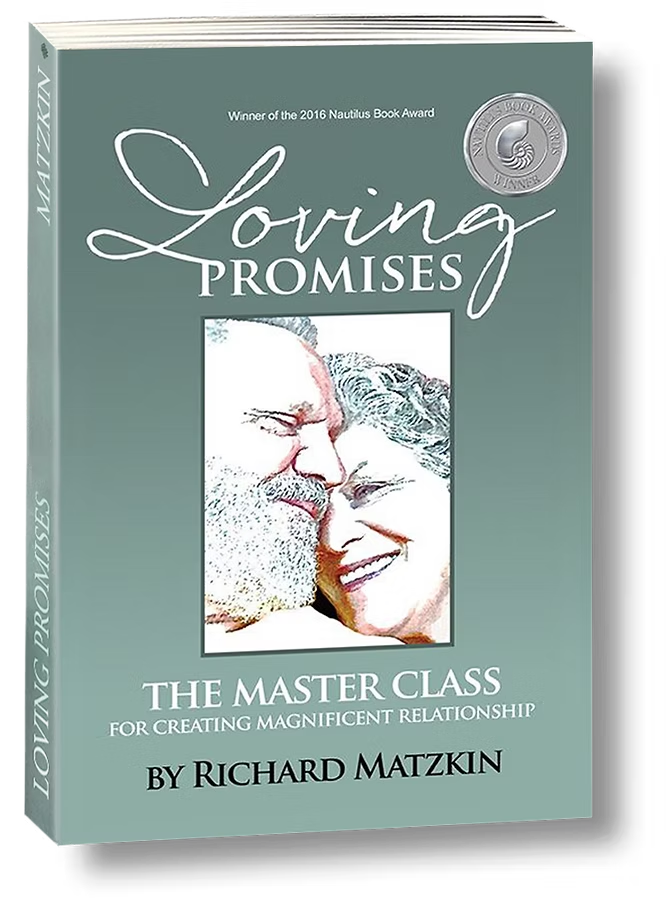

LOVING PROMISES
The Master Class For Creating Magnificent Relationship
by Richard Matzkin
In this unique inquiry into the most profound incarnation of love, author Richard Matzkin looked to his extraordinary, three-decade-long marriage to Alice as a living laboratory to research the elements that comprise a truly loving, magnificent partnership. As a result, he discovered thirty-nine Loving Promises statements of intention you pledge to yourself, not your partner, that are the behavioral components of deep, abiding love.
These Promises are a profound path to transforming even a good relationship into a magnificent one.
2) Hold Me Tight by Dr. Sue Johnson
Dr. Sue Johnson developed Emotionally Focused Therapy (EFT), and Hold Me Tight brings that clinical framework directly to couples. The book identifies seven specific conversations that either deepen or erode emotional bonds.
Johnson's central argument is that adult romantic love is an attachment bond, not a rational contract. When partners feel emotionally unsafe, they cycle through predictable patterns of protest, withdrawal, and disconnection. The book names these patterns clearly and offers structured dialogues to interrupt them.
For older couples navigating decades of accumulated hurt, Johnson's language of attachment injuries and emotional responsiveness provides a precise vocabulary for old wounds. The writing is clinical in origin but warm in execution. Johnson understands that the longing to feel held and known does not diminish with age; if anything, it sharpens.
Best for: Couples experiencing recurring conflict, emotional distance, or disconnection after a significant loss.
3) The Five Love Languages by Gary Chapman
Gary Chapman's The Five Love Languages identifies five distinct ways people give and receive emotional connection: words of affirmation, acts of service, receiving gifts, quality time, and physical touch. The core argument is that partners often love each other sincerely but in mismatched languages, creating a felt deficit of connection.
The book has sold more than 20 million copies and remains widely recommended by therapists. Its strength is practical simplicity: Chapman provides accessible self-assessments and specific behavioral suggestions for each language.
For older couples, the physical touch and quality time languages carry particular weight as bodies change and time together becomes more consciously valued. The book encourages partners to ask directly what makes the other feel genuinely loved rather than assuming their own preference maps onto their partner's needs.
Best for: Couples who feel disconnected despite mutual goodwill and want a clear, actionable framework for emotional attunement.
4) Emotional Intimacy by Robert Augustus Masters, Ph.D.
Robert Augustus Masters, Ph.D. approaches emotional intimacy as a practice of emotional literacy rather than a relational technique. The book treats emotions as information, arguing that the inability to fully experience and name feelings is the primary barrier to genuine closeness.
Masters covers the full emotional spectrum in dedicated chapters: fear, anger, grief, joy, shame, jealousy, and awe. Each chapter examines how that emotion operates when suppressed versus when met with honest attention. He distinguishes carefully between anger and aggression, shame and guilt, and catharsis and healing, separations that most popular relationship books collapse.
The book also addresses gender differences in emotional expression with nuance rather than stereotype. For older adults who grew up in eras that discouraged emotional disclosure, Masters offers a patient, non-judgmental re-education. The writing is dense but rewarding.
Best for: Readers who feel emotionally shut down, numb, or disconnected and want to understand why.
5) Love And Time by Richard Matzkin
Love and Time is the book I wrote most directly from the marrow of lived experience. It examines what happens to love, desire, companionship, and identity as decades accumulate and as the body and circumstances inevitably change.
The subtitle, Embracing Change, Growth And Mature Relationships In The Winter Of Life, names the territory honestly. This is a book about loss as much as love, about what endures when youth, health, and certainty erode. Connie Zweig, Ph.D. described it as "a profound contemplation on the twin mysteries of love and time," and Harry R. Moody, Ph.D. called it "indispensable."
Alice appears throughout, not as a character but as a living presence, the way a long partnership saturates every page of a life. The book treats emotional intimacy in later life as something qualitatively different from young love: slower, more honest, more rooted in acceptance of impermanence.
Best for: Older adults, long-term partners, and anyone facing significant life change who wants a companionable, experience-shaped reflection on love's later seasons.
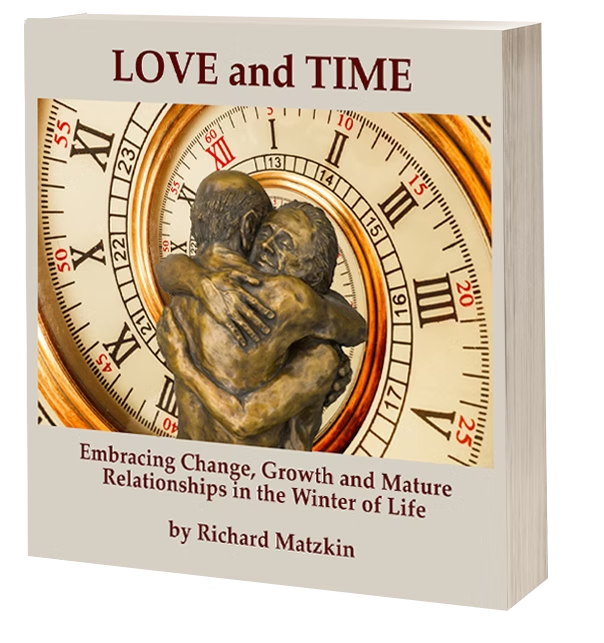
LOVE AND TIME
Embracing Change, Growth And Mature Relationships In The Winter Of Life.
by Richard Matzkin
Love and time – two of the most important aspects of human existence. Over time, as we age and mature, our love matures and ripens. This book explores, from many different angles, the powerful influence of the passage of time on a person’s life and relationships.
“LOVE and TIME is unlike any other book on aging I have read. The voice of lived experience, rendered thoughtfully, profoundly, provocatively. Really important. Indispensable”. – Harry R. Moody PhD
“A wonderful and unique book. A profound contemplation on the twin mysteries of love and time, as lived by a man with the heart of an artist and the soul of a poet”. – Connie Zweig PhD
“I have never read a book like LOVE and TIME. It gave me a visceral experience of what it can mean to be fully, passionately present to all the painful losses and shining gifts that accompany this precious stage of life.” – Ron Pevny MA
“There is a love story woven into the pages that is so deep and passionate, it would make even younger aspire to some day experience the greatest joy of all; growing old together." – Carol Orsborn PhD
6) Getting The Love You Want by Harville Hendrix and Helen LaKelly Hunt
Harville Hendrix and Helen LaKelly Hunt developed Imago Relationship Therapy, and Getting the Love You Want is its foundational text. The book argues that romantic partners are unconsciously selected to recreate and potentially heal early childhood emotional wounds.
The central concept is the Imago, a composite unconscious image of the primary caregivers that shapes adult partner selection. Hendrix and Hunt provide structured couples dialogue exercises designed to interrupt reactive communication and create a space of genuine listening and presence.
For older couples, the Imago framework illuminates why certain conflicts repeat across decades. The book's exercises require patience and honesty rather than quick effort. The 2019 updated edition includes additional material on conscious partnership and social dimensions of intimate relationships.
Best for: Couples who recognize deep, repeating patterns and want a psychologically grounded framework for interrupting them.
7) The Relationship Cure by John Gottman
Dr. John Gottman's research at the University of Washington produced decades of observational data on what distinguishes lasting couples from those who separate. The Relationship Cure distills that data into a single organizing concept: the emotional bid.
An emotional bid is any attempt, large or small, to connect with another person. Gottman's research shows that the consistent pattern of turning toward bids rather than ignoring or rejecting them predicts long-term relationship health more reliably than grand gestures or romantic chemistry.
The book covers bids across five emotional command systems, including attachment, exploration, and play. For older adults, the focus on small daily moments of connection resonates deeply. Long partnership lives inside the accumulation of ten thousand small turning-toward moments, not inside a handful of memorable occasions.
Best for: Readers who want a research-grounded map of how emotional intimacy is built and sustained through everyday interaction.
8) Love Worth Making by Stephen Snyder, M.D.
Stephen Snyder, M.D. is a psychiatrist and sex therapist whose book addresses the intersection of erotic desire and emotional intimacy with rare clinical honesty and warmth. The book argues that most sexual problems in long relationships are problems of self-regulation and presence rather than technique or physical capacity.
Snyder's concept of the erotic mind distinguishes between the self that performs and the self that genuinely feels desire. He argues that lasting sexual intimacy requires partners to cultivate erotic selfhood, an honest relationship with their own desire that does not depend entirely on the partner's response.
For older couples navigating changing bodies and long-term familiarity, Snyder's framing is genuinely liberating. He treats desire in later life as real and worth cultivating rather than as something that naturally expires. The tone is neither clinical nor salacious; it is humane and precise.
Best for: Long-term partners who want to understand the emotional and psychological roots of desire and physical closeness.
What Makes A Book Useful For Older Couples
Most popular relationship books are written with younger couples in mind. For older adults, long-term partners, and those navigating the later seasons of life, different criteria apply.
Emotional Safety And Honest Communication
Useful books for older couples prioritize emotional safety as a precondition for honest disclosure. Partners who have lived together for decades carry accumulated grievances, unspoken fears, and tender spots that younger couples have not yet developed. A book that treats communication as a simple skill set misses the weight of that history.
Effective communication frameworks in this context address repair as much as expression. Gottman's work on bids for connection and Johnson's attachment-based dialogues both recognize that safety must be rebuilt before honesty can flow freely.
Room For Changing Bodies And Desire
Books useful to older couples acknowledge that bodies change and that desire changes with them. Works that treat physical intimacy as a fixed capacity rather than an evolving one do not serve this readership.
Snyder's Love Worth Making and my own Love and Time both address the erotic and emotional dimensions of aging directly. Physical change does not end the conversation about intimacy; it reshapes it, often toward greater tenderness, patience, and presence.
Attention To Grief, Time, And Long Partnership
Long partnership accumulates grief alongside love: lost friends, declining health, changed roles, and the knowledge of mortality. Books that treat emotional intimacy without acknowledging loss offer an incomplete picture.
Alice and I addressed these themes directly in The Art of Aging, which combined Alice's paintings and my sculpture with honest writing about aging, sensuality, spirituality, and death. The book received both the IPPY Award and the Nautilus Award, and two of Alice's paintings from the collection entered the permanent collection of the Smithsonian's National Portrait Gallery. Grief and beauty belong together in a complete account of long love.
A Tone Of Kindness Rather Than Blame
Books that frame relationship problems primarily as one partner's failure to perform correctly tend to generate shame rather than growth. For older adults who have invested decades in a partnership, a tone of mutual accountability and compassion is far more useful than a tone of correction.
Richard Matzkin's MANifesto and Becoming Love-able both take this approach with men specifically, asking not what men are doing wrong but what kind of person a man might grow into. Jed Diamond, Ph.D. described MANifesto as following "the ancient tradition of warriorship," which captures the orientation: strength directed toward tenderness rather than away from it.
About the Author
Frequently asked questions
What is the 72 hour intimacy rule?
The "72-hour rule" is a flexible relationship guideline suggesting that couples try to engage in some form of intimacy or intentional connection at least once every three days. It does not mandate sex exclusively; physical touch, holding hands, or a deep uninterrupted conversation also count. The goal is to establish consistency and prevent partners from growing distant over long periods.
How to fix lack of emotional intimacy?
Fixing emotional intimacy requires consistency, vulnerability, and intentional effort from both partners. Key strategies include:
- Prioritizing Quality Time: Set aside distraction-free time daily or weekly to talk about your internal experiences rather than just daily chores.
- Practicing Active Listening: Give your partner your full attention and validate their emotions without jumping straight into "fixing" their problems.
- Building Emotional Safety: Take the risk to be vulnerable and share your feelings and fears openly.
- Seeking Professional Support: Couples counseling provides a neutral space to uncover deep-seated relationship patterns and improve communication.
What are the 3 C's of intimacy?
While relationship experts often use different terms, the "3 C's" commonly refer to the core pillars required for a healthy and satisfying intimate bond:
- Communication: Honest, open, and non-judgmental dialogue about needs, boundaries, and desires.
- Commitment: The shared, intentional dedication to nurturing the relationship and supporting one another, regardless of your mood or daily stress.
- Closeness / Connection: The emotional safety and willingness to let your partner see you exactly as you are without the fear of excessive rejection.
What does lack of emotional intimacy do to a woman?
A lack of emotional intimacy can negatively affect a woman's physical and mental well-being. Women who lack emotional connection in their relationships frequently report feelings of loneliness, rejection, and diminished self-esteem. Biologically, the lack of bonding can lead to disrupted oxytocin levels and chronically elevated cortisol (the stress hormone), which can manifest as heightened anxiety, depression, insomnia, and physical tension.
References
- Modern Insight Therapy. (2025, May 14). Improving Intimacy: What's Normal and How to Address It. Modern Insight Therapy
- The Taylor Birnbaum Show. (2025, January 18). The 72 Hour Rule... Instagram
- Counselling Directory. (2015, October 2). The 'three Cs' of intimate relationships. Counselling Directory
- AllOne Health. (2018, January 19). Three C's for Happy Couples. AllOne Health
- Royacounselling. (2025, December 9). What Lack of Intimacy Does to a Woman: Emotional & Physical Impact. Roya Counselling
